Many drivers want better sound in their car but are unsure which speaker size actually fits their vehicle — or whether a coaxial speaker or a two-way component system is the better choice. Selecting the wrong size or system often leads to unnecessary installation work, disappointing sound quality, or wasted budget.
This guide explains how to choose the correct speaker size, which system type fits your use case, and how subwoofer options integrate into the overall setup. The goal is not just compatibility, but predictable sound quality and a clean installation.
A reliable starting point is selecting your exact vehicle model via auto-lautsprecher nach Fahrzeugen finden, where compatible speaker sizes, complete sets, and required accessories are matched precisely to factory mounting points.
📖 Understanding Speaker Sizes and System Types
Car speakers are available in common sizes such as 10 cm (4″), 13 cm (5.25″), 16 / 16.5 cm (6–6.5″), and 20 cm (8″), as well as 5×7″ and 6×9″ oval speakers, which are often used in US vehicles or rear shelves.
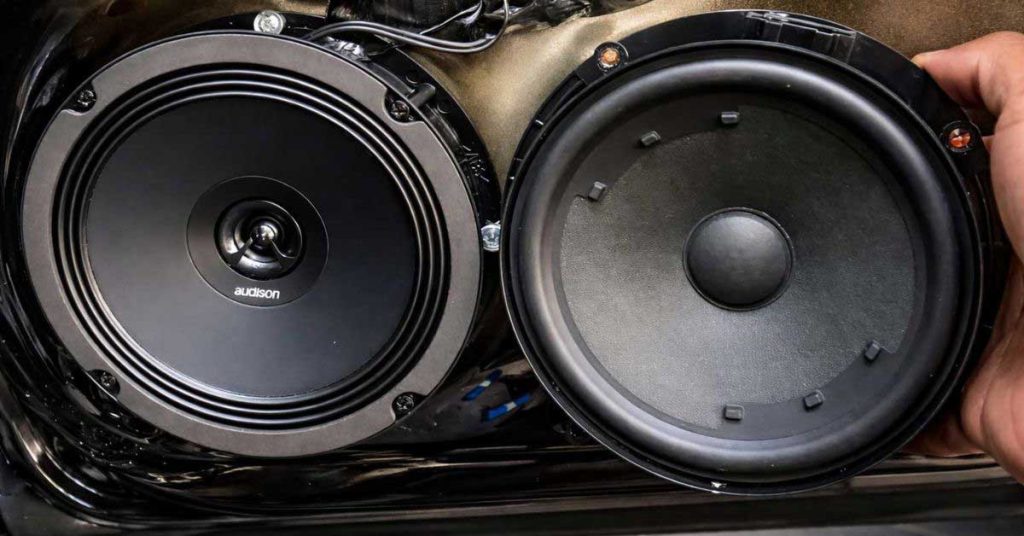
From around model year 2000 onward, many vehicles are designed for a two-way component system in the front, with a mid-woofer mounted in the door and a tweeter located in the A-pillar or mirror triangle. This layout improves sound staging and clarity because high frequencies are positioned closer to ear level.
Rear doors or rear decks often use coaxial speakers, because they are easier to install and combine midrange and tweeter into one unit. If dedicated tweeter mounting points exist, a two-way system can also be used in the rear, but this is optional rather than mandatory.
Vehicle-specific speaker sets often include mounting rings and adapter cables, which allow plug-and-play installation on the factory radio without cutting original wiring.
🔧 Practical Installation Tips – Step by Step (EEAT)
1) Preparation and Tools
Start by confirming your vehicle model and factory speaker size. Prepare trim removal tools, Torx drivers, clip levers, a multimeter, sound-deadening materials (butyl mats or acoustic fleece), adapter cables, and mounting rings. Proper preparation reduces installation time and prevents damage.
2) Initial Check and System Baseline
Check factory radio settings first. Set balance, fader, and EQ to neutral, because incorrect settings distort test results later. Test door panels for vibrations; if panels already rattle, sound deadening should be planned. A frequent mistake is skipping adapter cables, which often causes loose connections and intermittent sound.
3) Installation Process
- Remove the door panel carefully and secure all connectors.
- Remove the factory speaker and clean the mounting surface.
- Install the mounting ring and prepare wiring using adapters.
- Install the mid-woofer and tweeter; securely mount the crossover when using a two-way component system.
- Perform a function test before final tightening.
4) Final Testing and Adjustment
Check left/right balance, treble clarity, and phase alignment. Voices should sound centered because correct polarity preserves stereo imaging. Test bass response at moderate volume to ensure there is no rattling.
5) Typical Problems and Solutions
- Rattling noises usually indicate insufficient door damping.
- Thin sound often results from incorrect tweeter orientation or crossover settings.
- Low maximum volume occurs because factory radios deliver limited power, making an amplifier the logical next upgrade.
6) Expansion and Optimization Options
- Under-seat active subwoofers improve low-end presence with minimal space usage.
- Active trunk subwoofers deliver deeper bass with moderate installation effort.
- Passive subwoofer with amplifier offers maximum output and control but requires more planning, wiring, and tuning.
DSP or advanced EQ can further improve staging and tonal balance.
7) Safety and Completion
Secure all screws and clips, protect cables from abrasion, and avoid airbag wiring. Finish with a listening test at moderate volume to confirm stability.
For detailed installation planning and error prevention, structured Car-hifi Einbau Hilfe provides practical, vehicle-independent guidance.
🚗 Vehicles and Typical Upgrade Scenarios
These principles apply to most mainstream brands, including Alfa Romeo, Audi, BMW, MINI, Chevrolet, Chrysler, Citroën, Dacia, Fiat, Ford, Honda, Kia, Lexus, Mazda, Mercedes, Mitsubishi, Nissan, Opel, Peugeot, Renault, Seat, Škoda, SsangYong, Suzuki, Toyota, and VW.
Common scenarios include:
- Front upgrades using two-way component systems
- Rear upgrades using coaxial speakers or two-way systems if space allows
- Bass upgrades via under-seat, active, or passive subwoofers
🎶 Technical Factors That Shape Sound Quality
Efficiency and Power
Factory radios typically provide 15–20 W RMS per channel. Speakers with higher sensitivity (around 90 dB or more) sound louder and fuller because they convert electrical power into acoustic output more efficiently. For higher volume and better control, an external amplifier becomes necessary.
Crossovers and Frequency Separation
Quality crossovers protect tweeters from low frequencies and ensure smooth transitions between drivers. This is why a two-way component system usually delivers clearer highs and a more precise soundstage than a coaxial speaker in the front.
Installation Quality and Sound Deadening
Proper door sound deadening increases mid-woofer efficiency and reduces resonance. This directly results in tighter bass, improved midrange clarity, and less distortion.
📊 Comparing System and Subwoofer Options
Coaxial Speaker vs. Two-Way Component System
Coaxial speakers are fast and uncomplicated, making them ideal for rear positions or vehicles without tweeter mounts. A two-way component system delivers clearer highs, better staging, and more dynamics, but requires careful installation of tweeters and crossovers. For front systems in modern vehicles, a two-way component system is often the better choice.
Subwoofer Options
- Under-seat subwoofers: compact, subtle bass enhancement
- Active trunk subwoofers: deeper bass with reasonable effort
- Passive subwoofer + amplifier: maximum output and headroom, but higher complexity
🔍 Quick Decision Guide
- Unsure about speaker size? → Select your vehicle model and confirm factory dimensions.
- Better sound on factory radio? → Choose high-sensitivity speakers (≥90 dB).
- Clear front soundstage? → Use a two-way component system in the front.
- More bass without major work? → Add an under-seat or active subwoofer.
🔊 Expertise from auto-lautsprecher.eu
auto-lautsprecher.eu provides experience-based guidance for drivers who want to upgrade their car audio system correctly. The platform focuses on vehicle-specific speaker selection, realistic installation planning, and common mistakes seen in real-world upgrades. Instead of generic advice, users are guided toward compatible speaker sizes, suitable system types, and installation-relevant accessories, making sound upgrades more predictable and technically sound.
✅ Conclusion
Choosing the correct speaker size and system type — coaxial speaker or two-way component system — is critical for both sound quality and installation effort. Selecting your vehicle model, using vehicle-specific kits with adapters and mounting rings, and planning door sound deadening from the start leads to consistent results.
For front systems, a two-way component system often delivers the best balance of clarity and staging. For quick rear upgrades, coaxial speakers are usually sufficient. When bass is desired, under-seat, active, or passive subwoofers offer scalable solutions.
Clean wiring, secure mounting, and a final functional test ensure long-term reliability and everyday usability — and ultimately, the sound upgrade drivers are aiming for.